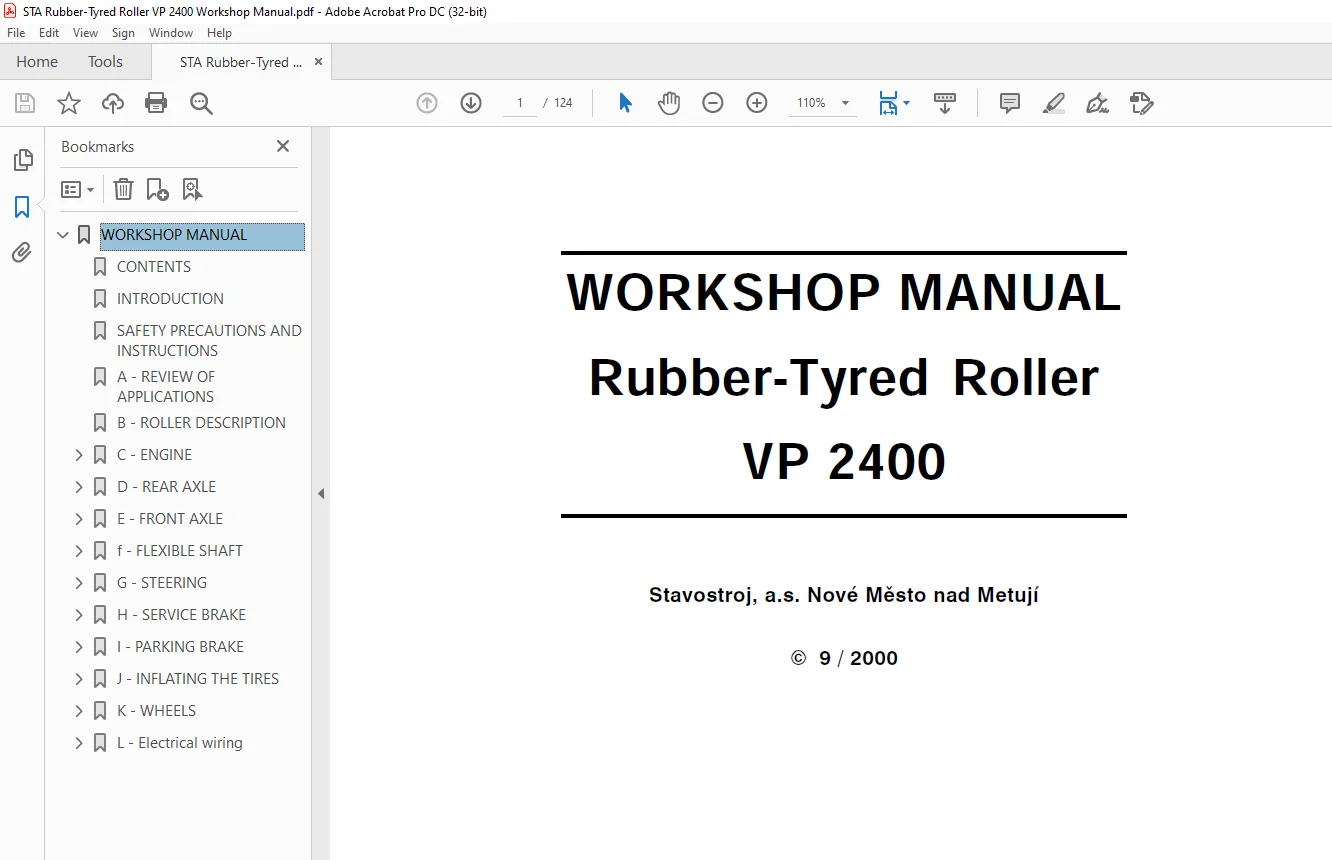
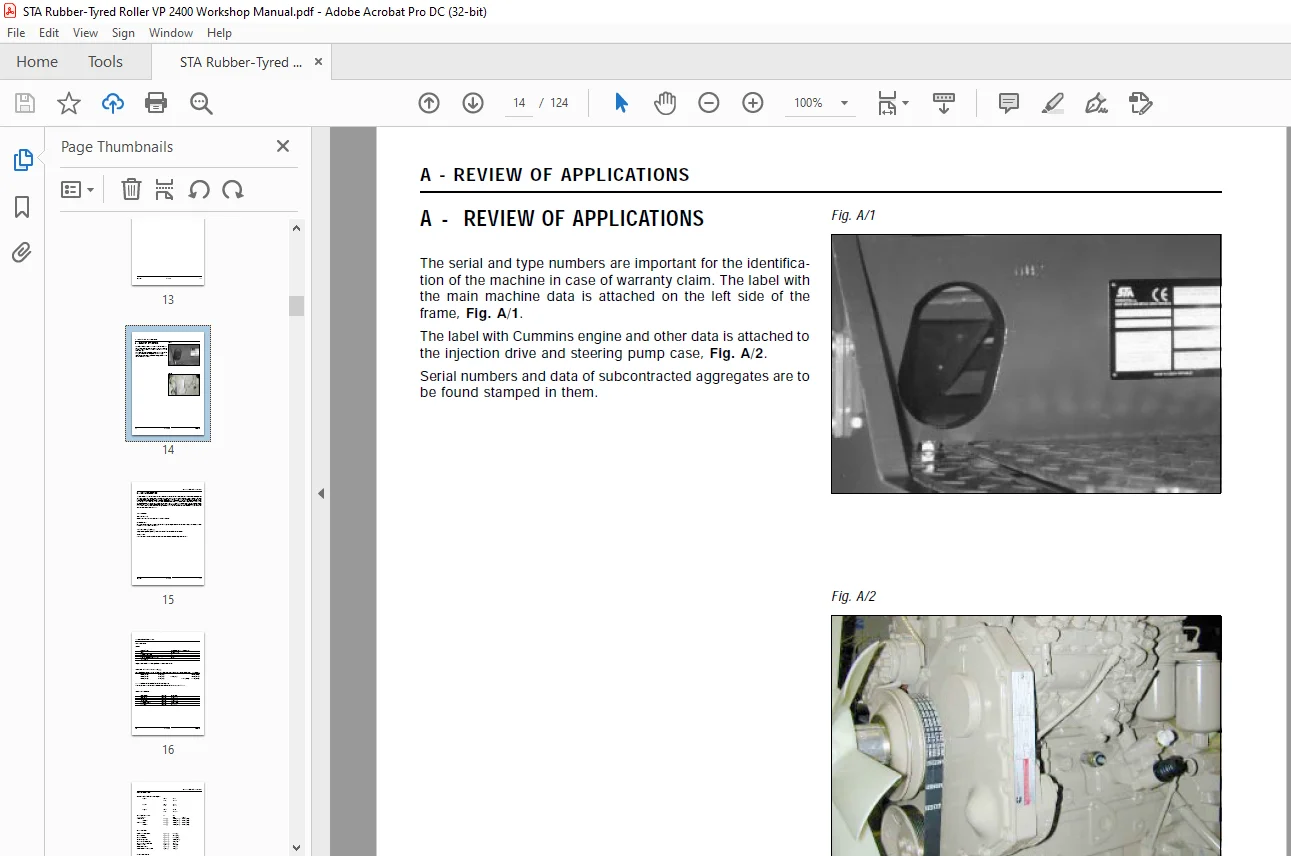
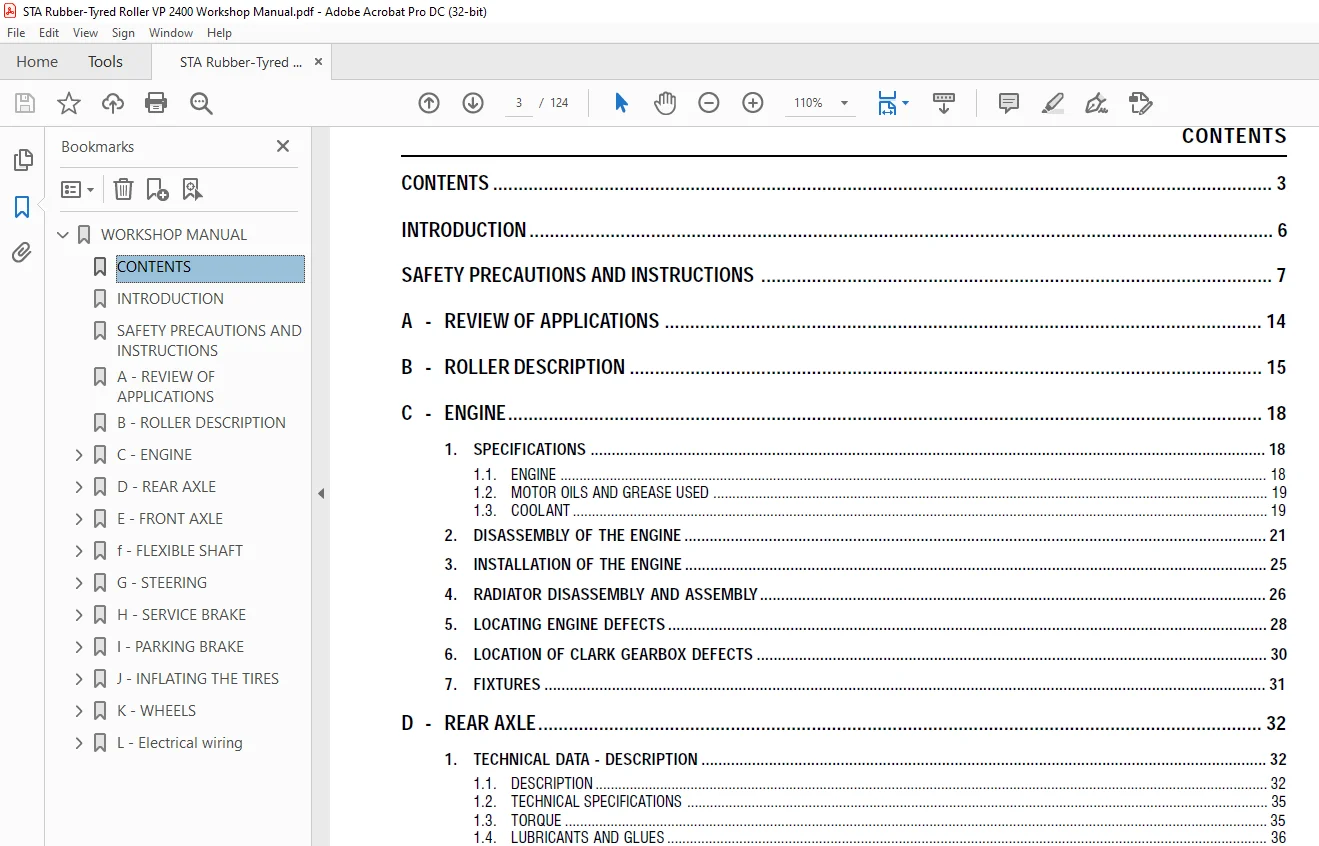
STA Rubber Tyred Roller VP 2400 WORKSHOP MANUAL – PDF DOWNLOAD
$25.95
STA Rubber Tyred Roller VP 2400 REPAIR MANUAL – PDF DOWNLOAD
Description
STA Rubber Tyred Roller VP 2400 WORKSHOP MANUAL – PDF DOWNLOAD
FILE DETAILS:
STA Rubber Tyred Roller VP 2400 REPAIR MANUAL – PDF DOWNLOAD
Language : English
Pages : 124
Downloadable : Yes
File Type : PDF
IMAGES PREVIEW OF THE MANUAL:
DESCRIPTION:
STA Rubber Tyred Roller VP 2400 REPAIR MANUAL – PDF DOWNLOAD
- INTRODUCTION
- The roller, series VP 2400, is designed for compacting operations of medium to large magnitudes in the construction of highways, railroads, airports, dams, industrial tracts, harbors, etc. Specifications of the machine, weight, tire sizes, turning radius, leveling of front wheels, and the first-rate engine, provide for an efficient roller with very good output, high reliability, and safety in operations.
- The fact that the inflation of tires can be adjusted continuously allows for compacting of all kinds of materials in a wide range of consistency, and for the optimal adaptation of the roller. The roller is well suited for compacting asphalt mixtures, hydraulically compacted mixtures, clay soils, and soil mixtures of sand and gravel. However, it is nor suited for rockfills.
- The roller operates under conditions specified in standards CSN IEC 721-2-1 (038900): WT, WDr, MWDr – that is mild, warm and dry, hot and dry environment at temperatures of –15 °C (5 °F) to 45 °C (113 °F). The roller is manufactured to most modern rules and standards of work safety. There exists danger of damage or injury, should the roller be applied incorrectly, by untrained personnel, or for other than specified purposes.
- The main purpose of this manual is to provide basic information for the disassembly, assembly, and service of the main construction elements of the roller. The manual consists of separate chapters in reference to the catalogue of spare parts, and contains data on assembly, adjustment, and instructions for the application of special tools and fixtures.
- The manufacturer improves the product continually under application of the most recently gained experience and know-how, and for that reason, reserves the right to install modifications that have not been included in the pictures, descriptions, and/ or construction details of this manual. This Manual is copyrighted and it is not permitted to copy and distribute it or its parts.
SAFETY PRECAUTIONS AND INSTRUCTIONS
THESE SAFETYREGULATIONS MUST BE OBEYED BY ALL THAT MAINTAIN THE ROLLER!
· The roller may be maintained only by a trained, certified, and experienced professional, or by the STA Service.
· Maintenance should always follow our Service Shop Manual. Each chapter contains special instructions for proper
maintenance procedures.
· Before using the roller, become acquainted with the Driver’s Manual, and make sure that you understand the equipment
of the roller completely.
· Never use the machine, unless you understand all control elements and the operation of the roller.
· Become acquainted with the site, where you work.
· Do not re-build or modify the roller, since the stability of the machine may be disturbed.
· Original parts and accessories have been designed especially for the roller
· Installation and use of spare parts not supplied with the roller or not authorized by the manufacturer may have a
detrimental effect on the operation and safety of the machine.
SAFETY PRECAUTIONS FOR REPAIR AND INSPECTION OF THE MACHINE
· Wear work clothes and shoes.
· When handling oil, fuel, and/or coolant always wear gloves.
· Wear glasses or goggles, when handling batteries.
· Situate the roller on a flat, firm ground before you start repair. Wedge the machine.
· Secure the frame and the drum against turning against each other by a safety pin and a push rod.
· Remove the key from ignition, disconnect batteries, and let hot parts cool off.
· Attach a warning label ”The Machine is being repaired” on the steering wheel and leave it there until finished.
· Wash the roller thoroughly. If using hot steam, avoid direct stream affecting electrical components and insulation, or cover
it beforehand.
· During assembly and service repair of particular assemblies, keep them clean. Protect removed parts from dirt.
· Clean removed parts and provide dust-free shop area with a necessary area for depositing parts.
· Be careful with cleaners. Do not use gasoline or other flammables!
· Dry cleaned parts and apply anti-corrosion oil – never use corroded parts!
· All tools, hoists, supports and other fixtures must be in a useable shape and condition.
· Hoists, cables, and chains should be of sufficient carrying capacity, and undamaged.
· Provide sufficient air supply, when starting the engine in closed areas.
· Before starting the roller, make sure that nobody is in the vicinity. The start of the engine must be announced by a warning
sound beforehand and after every pause before the roller starts moving. Persons on the machine or its vicinity must leave
after the sound. Sound, light, and hand signals should be used as specified in CSN 27 7012 standard, Appendix no.1.
· Do not adjust while moving.
· During work on a running engine, avoid contact with hot and rotating parts of the roller. Adjustments in such cases must
be done while another person is nearby, who has access to emergency switches and is in continuous contact with the
service person, so that the engine could be turned off immediately when needed.
· Use only specified types of motor, transmission, and hydraulic oils, and coolant.
TABLE OF CONTENTS:
STA Rubber Tyred Roller VP 2400 REPAIR MANUAL – PDF DOWNLOAD
WORKSHOP MANUAL.........................................................  1
	CONTENTS ...........................................................  3
	INTRODUCTION .......................................................  6
	SAFETY PRECAUTIONS AND INSTRUCTIONS ................................  7
	A - REVIEW OF APPLICATIONS ......................................... 14
	B - ROLLER DESCRIPTION ............................................. 15
	C - ENGINE ......................................................... 18
		1. Specifications .............................................. 18
		1.1. Engine .................................................... 18
		1.2. Motor oils and grease used ................................ 19
		1.3. Coolant ................................................... 19
		2. Disassembly of the engine ................................... 21
		3. Installation of the engine .................................. 25
		4. Radiator disassembly and assembly ........................... 26
		5. Locating engine defects ..................................... 28
		6. Location of CLARK gearbox defects ........................... 30
		7. FIXTURES .................................................... 31
	D - REAR AXLE ...................................................... 32
		1. TECHNICAL DATA - DESCRIPTION ................................ 32
		1.1. Description ............................................... 32
		1.2. Technical specifications .................................. 35
		1.3. Torque .................................................... 35
		1.4. Lubricants and glues  ..................................... 36
		2. POSSIBLE DEFECTS AND REMEDIES ............................... 36
		3. DISASSEMBLY OF AXLE ......................................... 37
		3.1. Preparations .............................................. 37
		3.2. Axle disassembly from the machine ......................... 37
		3.3. DISASSEMBLY OF DRIVESHAFT ................................. 38
		3.4. disassembly OF Drive housing  ............................. 40
		3.5. Cleaning and inspecting parts ............................. 42
		4. AXLE ASSEMBLY ............................................... 43
		4.1. Drive housing assembly .................................... 43
		4.2. Gearbox assembly .......................................... 50
		4.3. Assembling axle to the machine ............................ 53
		5. Differential lock ........................................... 54
		5.1. DESCRIPTION ............................................... 54
		5.2. Possible defects and remedies ............................. 56
		6. FIXTURES .................................................... 57
	E - FRONT AXLE ..................................................... 58
		1. TECHNICAL DATA .............................................. 58
		1.1. Description ............................................... 58
		1.2. Specifications ............................................ 58
		1.3. Torque values ............................................. 59
		1.4. Lubricants and glues ...................................... 59
		2. DEFECTS AND REMEDIES ........................................ 60
		2.1. Inspection of installation of four front wheels  .......... 60
		3. AXLE DISASSEMBLY ............................................ 61
		3.1. Preparatory work .......................................... 61
		3.2. Disassembly of axle from the equipment  ................... 62
		3.3. Disassembly of guiding pipe of the front axle ............. 63
		3.4. Disassembly of fork ....................................... 64
		3.5. Cleaning and inspection of parts .......................... 66
		4. INSTALLATION OF FRONT AXLE .................................. 67
		4.1. Installation of guiding pipe and fork ..................... 67
		4.2. Assembly of wheel hubs and shaft .......................... 69
		4.3. Assembly of fork and shaft assembly with wheel hubs ....... 71
		4.4. Assembly of axle to the machine ........................... 73
		5. FIXTURES .................................................... 74
	f - FLEXIBLE SHAFT ................................................. 77
		1. Specifications .............................................. 77
		1.1. Description ............................................... 77
		1.2. Specifications ............................................ 77
		1.3. Torque .................................................... 77
		1.4. Grease .................................................... 77
		2. Possible defects and remedies ............................... 78
		3. Disassembly and re-assembly ................................. 78
		3.1. Preparatory work .......................................... 78
	G - STEERING ....................................................... 79
		1. Specifications - description ................................ 79
		1.1. Description ............................................... 79
		1.2. Technical data ............................................ 79
		1.3. Lubricants and glues ...................................... 82
		2. Possible defects and remedies ............................... 83
		3. DISASSEMBLY AND ASSEMBLY OF THE STEERING ASSEMBLY ........... 84
		3.1. Preparatory work .......................................... 84
		3.2. DISASSEMBLY OF STEERING hydraulic generator  u10 .......... 85
		3.3. DISASSEMBLY OF POWER STEERING ............................. 86
		3.4. DISASSEMBLY OF LINEAR hydraulic motor   ................... 87
		3.5. Removal of power steering tank ............................ 88
		3.6. Removal and installation of the lever assembly  ........... 89
		4. Adjustment of toe-in ........................................ 90
		5. Fixtures .................................................... 92
	H - SERVICE BRAKE .................................................. 93
		1. Specifications .............................................. 93
		1.1. Description ............................................... 93
		1.2. Specifications ............................................ 96
		1.3. Brake fluid ............................................... 98
		2. Defects ..................................................... 98
		3. Disassembly and installation  ...............................100
		3.1. Preparations ..............................................100
		3.2.  Disassembly of pedal brake ...............................100
		3.3. Disassembly of booster ....................................101
		3.4. Disassembly of brake system ...............................102
		4. Brake shoes adjustment ......................................103
		5. Service brake venting .......................................104
		6. Machining brake drums .......................................104
	I - PARKING BRAKE ..................................................105
		1. Specifications - description ................................105
		1.1. Description ...............................................105
		1.2. Specifications ............................................105
		2. Maintenance .................................................106
		2.1. Disassembly and installation of the disk brake ............106
		2.2. Removal and installation of the spring-loaded cylinder ....107
	J - INFLATING THE TIRES ............................................108
		1. Specifications ..............................................108
		1.1. Description ...............................................108
		1.2. Specifications ............................................108
		2. Removal and installation ....................................109
		2.1. Control valve .............................................109
		2.2. Rotor  ....................................................109
	K - WHEELS .........................................................110
		1. Specifications ..............................................110
		1.1. Description ...............................................110
		1.2. Specifications ............................................110
		2. Removal of wheels ...........................................110
		2.1. Preparation for work ......................................110
		2.2. Front axle wheels .........................................110
		2.3. Rear axle wheels ..........................................111
		3. Removal and installation of tires ...........................112
		4. Installation of wheel to the machine ........................112
		5. Safety valve adjustment .....................................112
	L - Electrical wiring ..............................................113
		1. DESCRIPTION .................................................113
		1.1. Battery breaker ...........................................114
		2. Battery .....................................................116
		2.1. Specifications ............................................116
		2.2. Operation .................................................116
		2.3. Indications of full charge ................................117
		2.4. Service during operations .................................117
		2.5. Safety regulations ........................................118
		3. Alternator ..................................................119
		3.1. Checking the alternator on the roller .....................119
		3.2. Determining defects of alternator-regulator ...............120
		3.3. Voltage regulator .........................................120
		4. Starter .....................................................121
		4.1. Operation and maintenance .................................121
		4.2. Check of idling - on the machine ..........................121
		4.3. Starter defects ...........................................121
Contact us: [email protected]
S.M